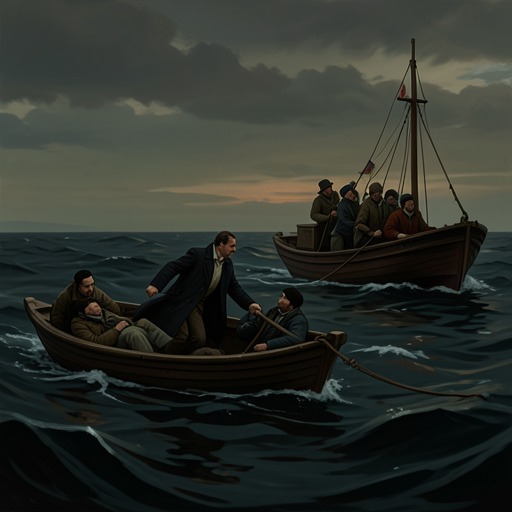
Cadena Rescues Viktor’s Crew
The Good ShepherdCadena’s rescue of Viktor’s crew reaches completion in the shadow of Viktor’s sinking, bringing one human danger to an end while confirming the loss of the ship itself. Krause draws Keeling close enough to verify the evacuation, hears the report that every crew member has been saved, and immediately gives Cadena the course and instructions needed to rejoin the convoy. The scene’s decisive turn is from rescue to renewed duty: the people are safe, but the ship that had carried them through exile and war is gone.
The Rescue Reaches Completion
As Cadena came alongside Viktor, Krause used a couple of helm orders to bring Keeling closer to the dark patch where the two vessels met. The rescue is first registered at a distance: a few words carried over the water from someone using a speaking-trumpet, then a sonar talker’s report of loud breaking-up noises. The sounds mark the physical end of Viktor even before the scene’s people can confirm the rescue’s outcome.
Cadena’s siren sounded four blasts in the night: “F” for Fox, the signal that rescue was complete. Krause did not treat that signal as sufficient by itself. He brought Keeling carefully within hailing distance, watched Cadena as she turned, and stepped out with a bull-horn. The close approach let him speak directly to the rescue vessel, but it also required care between two ships moving alongside one another. The narration recalls Krause’s momentary mental picture of the British liaison officer falling between the grinding hulls; this was a feared accident, not an event that occurred.
Confirmation and Loss
Krause’s question was direct: “Have you saved everyone?” Cadena’s reply removed the remaining uncertainty: “Yes. We’ve got ‘em all.” The exchange establishes that the evacuation was complete and that no one from Viktor’s crew had been left behind. For Krause, the answer brought great relief, closing the immediate human question that the siren alone could not settle.
That confirmation coincides with a much larger loss. The breaking-up noises are described as Viktor’s requiem; the ship had escaped Gdynia two and a half years earlier in defiance of the Luftwaffe and made its way out of the Baltic in the face of the Nazi Navy. For those two and a half years, it had fought a desperate fight and served as the only home left to its exiled crew. Its sinking therefore ends more than a vessel’s passage through the night: it ends the crew’s remaining home, even as the rescue preserves every life aboard.
From Evacuation to Convoy Duty
Once Cadena had confirmed that everyone was safe, Krause gave her a new course: “Course zero-eight-seven.” The speaking-trumpet repeated “Eighty-seven,” confirming the instruction across the water. Krause then ordered Cadena to make her best speed to rejoin the convoy. Cadena’s reply—“Twelve knots if I can”—makes clear that the return would be made at the best speed available, not at a speed she could guarantee.
Krause paired the order to rejoin with an escort plan. He told Cadena, “I’ll screen you ahead,” and directed her to use the modified zig plan, Number Seven. When the speaking-trumpet began to question the instruction, Krause cut off the objection: “That’s an order,” and specified that the plan was to begin at zero minute. The details make the transition immediate and operational. Cadena is not left at the scene once the rescue is done; Keeling is to cover her return, while a designated zigzag plan governs her movement toward the convoy.
Significance in the Sequence
The scene holds two outcomes together without confusing them. Cadena has saved Viktor’s crew, and the ship’s loss is nonetheless final. The siren’s completion signal, the sonar report, and Krause’s question each answer a different part of the moment: the rescue has ended, Viktor is breaking up, and everyone has been accounted for. The sequence gives relief its proper place without turning it into a reprieve for the ship.
Krause’s response also shows how quickly a completed rescue becomes part of the convoy’s continuing protection. He checks the human outcome himself, then assigns a course, speed, screen, and plan for Cadena’s return. His orders do not diminish the loss; they place the surviving crew and their rescue vessel back within the demands of the operation. The event closes with Viktor gone and its people saved, but not with the escorts’ work finished.